
Epigenetics: How the Epigenome Regulates Gene Expression Beyond DNA
Why the Genome Is Fixed — but Its Expression Is Dynamic

Biology is dominated by a powerful idea: DNA determines destiny. The discovery of the double helix by James Watson and Francis Crick in 1953, followed by the decoding of the genetic code, reinforced a gene-centric view of life. Genes are seen as stable blueprints. Variation in DNA sequence explained variation in traits and disease.
For decades, this idea shaped modern biology — but it left something important unexplained.
Two cells in your body a neuron and a hepatocyte contain identical DNA sequences, yet they exhibit radically different structures and functions. Identical twins share nearly indistinguishable genomes, yet they diverge in disease risk as they age.
What explains this divergence?
The answer lies not in changes to the DNA sequence, but in changes to how genes are regulated.
This is the domain of epigenetics. It is a rapidly growing area of science that focuses on the processes that help direct when individual genes are turned on or off.
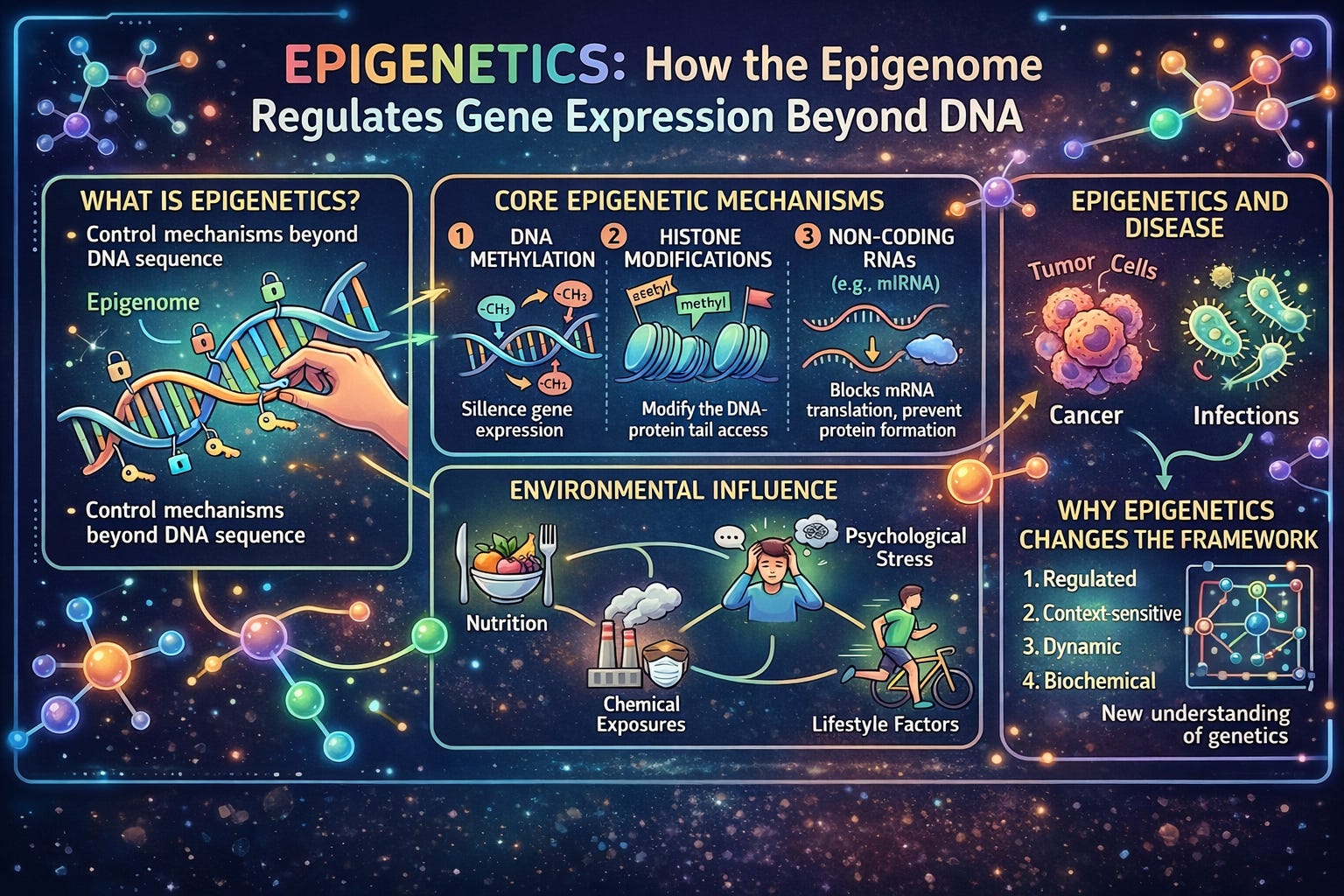
Scientific illustration generated using AI (2026).
What Is Epigenetics?
The term “epigenetics” was originally introduced by developmental biologist Conrad Waddington in the 1940s to describe how genotype gives rise to phenotype during development. The prefix “Epi” means above or on top of; epigenetics refers to chemical markers that sit on top of DNA.
In modern molecular biology, epigenetics refers to:
Heritable changes in gene expression that occur without alterations in the DNA sequence.
These changes are mediated by the epigenome — a complex system of chemical modifications to DNA and chromatin that regulate transcriptional activity. If the genome is the sequence of letters, the epigenome is the regulatory grammar.
Unlike genetic mutations, epigenetic changes are often reversible and influenced by environmental factors (e.g., diet, stress, chemicals). It controls gene expression, determining if a cell becomes a skin cell, brain cell, or heart cell. Poor diet, smoking, and stress can cause harmful changes that increase disease risk (e.g., cancer, diabetes)
Core Epigenetic Mechanisms
Let us explore the core molecular mechanisms that govern this regulatory system:
1. DNA Methylation
DNA methylation is the addition of a methyl group (–CH₃) to the 5-carbon of cytosine residues, most commonly at CpG dinucleotides. This reaction is catalyzed by DNA methyltransferases, primarily DNMT1, DNMT3A, and DNMT3B. Methylation of gene promoter regions is generally associated with transcriptional repression. It plays essential roles in maintaining genomic stability and regulating normal cellular differentiation.
2. Histone Modifications
DNA is wrapped around histone proteins (H2A, H2B, H3, and H4) to form nucleosomes, and the protruding histone tails undergo various post-translational modifications, including acetylation, methylation, phosphorylation, and ubiquitination. These chemical marks regulate chromatin structure and gene expression. Histone acetylation, mediated by histone acetyltransferases (HATs), generally leads to relaxed chromatin and increased transcription, whereas histone deacetylation by histone deacetylases (HDACs) results in chromatin condensation and transcriptional repression.
3. Non-coding RNAs
Non-coding RNAs (ncRNAs) are RNA molecules that regulate gene expression without encoding proteins and represent a crucial layer of epigenetic control. Major classes include microRNAs (miRNAs), small interfering RNAs (siRNAs), and long non-coding RNAs (lncRNAs). These molecules influence gene expression through several mechanisms, including post-transcriptional repression via mRNA degradation or inhibition of translation, recruitment of chromatin-modifying complexes to specific genomic loci, and scaffold functions that organize regulatory protein complexes.
Environmental Influence on the Epigenome
Environmental factors—including diet, psychological stress, chemical exposures, and lifestyle behaviors—can profoundly influence gene expression without altering the underlying DNA sequence, primarily through mechanisms such as DNA methylation and histone modification These epigenetic alterations enable cells to adapt to environmental conditions, but persistent or adverse exposures may dysregulate gene activity and increase disease susceptibility, including cancer, diabetes, and obesity.
Take nutrition, for example. Nutrients like folate and vitamin B12 provide the chemical building blocks needed for DNA methylation. Historical events such as the Dutch Hunger Winter showed that famine during pregnancy led to long-lasting metabolic and epigenetic changes in children decades later. Chemical exposures tell a similar story: pollutants, endocrine disruptors, and heavy metals can alter epigenetic marks, especially during fetal development when the epigenome is highly sensitive.
Additionally, psychological stress and lifestyle factors such as smoking and physical activity are associated with gene-specific methylation changes; for example, tobacco smoking is linked to reduced methylation at loci such as the AHRR gene, alterations that may be partially reversible following smoking cessation.
A landmark study by Michael Meaney and colleagues (Weaver et al., 2004) demonstrated that maternal care in rats alters DNA methylation patterns in the glucocorticoid receptor gene in offspring. These changes influenced stress responses in adulthood.
However, it is critical to emphasize:
Most environmentally induced epigenetic changes are context-dependent and not all are transmitted across generations.
Epigenetics and Disease
Epigenetic dysregulation is implicated in:
Cancer
Neurodevelopmental disorders
Autoimmune disease
Cardiometabolic conditions
Cancer
Cancer is not driven solely by genetic mutations; it also involves profound epigenetic dysregulation. One of the clearest examples is colorectal cancer, where tumor suppressor genes such as MLH1 can become transcriptionally silenced through promoter CpG island hypermethylation, without any change in the underlying DNA sequence. Silencing of MLH1, a DNA mismatch repair gene, leads to microsatellite instability, a hallmark of a subset of colorectal cancers. At the same time, many tumors exhibit global DNA hypomethylation, which can promote chromosomal instability and activation of oncogenic elements. In addition to DNA methylation changes, altered histone modification patterns and mutations in chromatin remodeling complexes further disrupt gene regulation.
Unlike fixed genetic mutations, epigenetic alterations are potentially reversible, which has led to the development of epigenetic therapies such as DNA methyltransferase inhibitors (e.g., azacitidine) and histone deacetylase inhibitors, now used in certain hematologic malignancies.
Infections
Microbes can alter host epigenetic mechanisms to modulate immune function, thereby enhancing their survival.
For example, Mycobacterium tuberculosis, the causative agent of tuberculosis, can induce epigenetic modifications in host immune cells. Infection has been shown to promote changes that silence the IL-12B gene, which plays a critical role in immune signaling. Downregulation of IL-12B impairs the host immune response, thereby facilitating the persistence and survival of Mycobacterium tuberculosis within the host.
Epigenetics does not mean:
Epigenetics is powerful, but it is often misunderstood. It does not mean that your thoughts can directly rewrite your DNA sequence. It does not suggest that healthy habits can completely override all inherited genetic risk. And it certainly does not imply that every trauma is automatically passed down across generations. Epigenetics refers to changes in how genes are turned on or off, not changes in the DNA sequence itself. While these regulatory changes can have important effects on health and development, they operate within biological boundaries and do not completely rewrite our genetic makeup.
Why Epigenetics Changes the Framework
Epigenetics reframes biological determinism.
It shows that gene expression is:
Regulated
Context-sensitive
Dynamic
Biochemically responsive
Your DNA sequence may be fixed —
its interpretation is not.
It is regulated.
And regulation is where environment, development, and molecular biology converge.
References
Baylin, S. B., & Jones, P. A. (2016). Epigenetic determinants of cancer. Cold Spring Harbor Perspectives in Biology.
Centers for Disease Control and Prevention. Epigenetics. U.S. Dept. of Health & Human Services. https://www.cdc.gov/genomics-and-health/epigenetics/index.html
Garm, C. et al. Genetic and environmental influence on DNA strand break repair: a twin study. Environ. Mol. Mutagen. 54, 414–420 (2013).
Heijmans, B. T., et al. (2008). Persistent epigenetic differences after prenatal exposure to famine. PNAS.
Ho, S. M. et al. Environmental epigenetics and its implication on disease risk and health outcomes. ILAR J. 53, 289–305 (2012).
Horvath, S. (2013). DNA methylation age of human tissues and cell types. Genome Biology.
Sharma, G., Upadhyay, S., Srilalitha, M., Nandicoori, V. K. & Khosla, S. The interaction of mycobacterial protein Rv1988 with host chromatin modulates histone methylation and gene expression. Nat. Commun. 6, 8922 (2015).
Strahl, B. D., & Allis, C. D. (2000). The language of covalent histone modifications. Nature.
Weaver, I. C. G., et al. (2004). Epigenetic programming by maternal behavior. Nature Neuroscience.
Figure created using AI-assisted image generation (OpenAI), 2026.